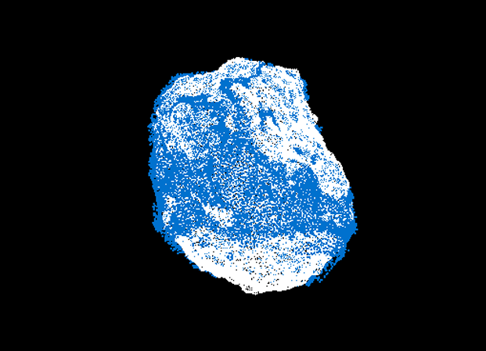
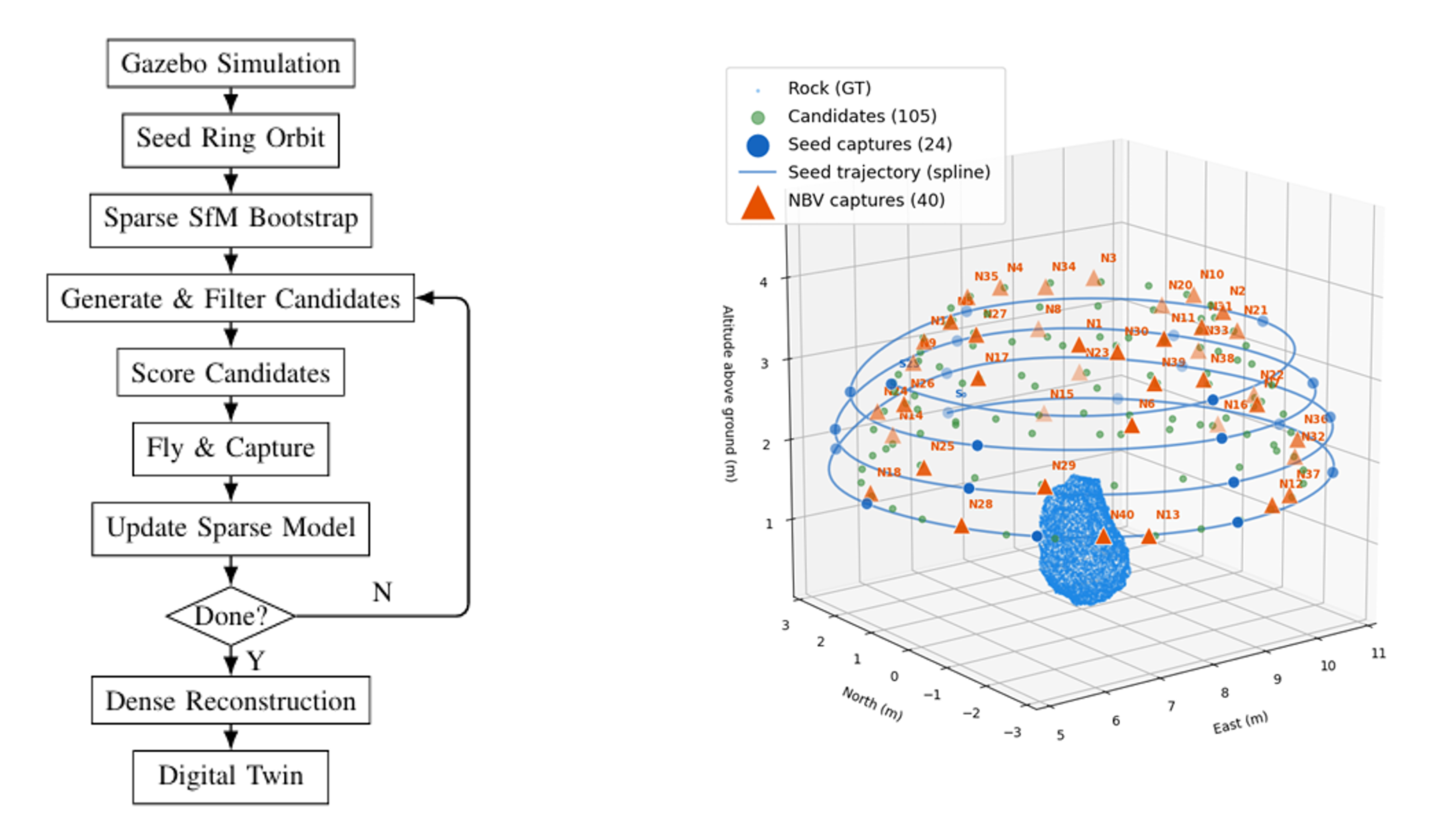
Simulation, next-best-view planning, and 3D reconstruction workflows for autonomous robotic mapping.
Sparse reconstruction output used to evaluate digital twin quality.Gazebo seed orbit, candidate viewpoint pool, and next-best-view capture plan.
Research Context
At ASU's DREAMS Laboratory, my work focuses on autonomous mapping, simulation, and 3D reconstruction workflows. The research connects robotic viewpoint planning with digital-twin construction, using an RGB UAV in simulation to decide which camera views best improve reconstruction quality.
The paper, "Hybrid Sparse-Model Next-Best-View Planning for Active 3D Reconstruction for Digital Twins," was accepted into the ICRA 2026 workshop Advances and Challenges in AI-Driven Automation and Robotic System Integration with Digital Twins. It plans directly from an incrementally updated Structure-from-Motion sparse point cloud rather than relying on a dense mesh, voxel map, or learned scene representation during flight.
The mission begins with a structured seed image capture around the target. After an initial reconstruction, candidate viewpoints are generated, filtered, scored, and selected based on the current sparse model.
Planning Strategies
The research compares co-visibility, baseline-aware repair, and hybrid next-best-view strategies that balance reconstruction improvement with viewpoint diversity, travel distance, and redundant observations.
Results Highlight
The best-performing oracle hybrid strategy achieved strong reconstruction fidelity on a simulated lunar rock task, including a 59.8 mm mean cloud-to-cloud error, 80% completeness at an 80 mm threshold, and 89% F-score at an 80 mm threshold.